
Legislative Update – September 2026
The Continuing Resolution Keeps Government Open Through December 11
President Trump signed the Continuing Appropriations and Extensions Act, 2027, into law on September 2. The continuing resolution (CR) keeps federal agencies operating through December 11, 2026, generally at current funding levels. It prevents an October 1 shutdown and gives Congress more time to negotiate full-year FY27 appropriations.
For NIH and NEI, however, a CR is a temporary bridge, not a final funding decision. Agencies must operate without full-year certainty, and new initiatives or awards may be slowed while funding remains unresolved. Congress could complete FY27 appropriations during the post-election session, enact another short-term extension before the holiday recess, or carry the debate into the new Congress beginning January 3, 2027. Each path affects the timing and predictability of research funding.
A Reprieve on Federal Grant Rules, but the Work is Not Done
The federal funding and policy environment for vision research is more stable than it was a year ago, but significant uncertainty remains. Congress has preserved the NEI as an independent NIH Institute, largely maintained NIH funding, and restored the Department of Defense Vision Research Program (VRP) at $10 million for FY26.
Yet flat funding continues to erode purchasing power, FY27 remains unresolved, and the House bill passed this summer included level funding for NEI and a provision preventing the Administration from increasing forward funding beyond current levels. At the same time, regulatory proposals could fundamentally change how federal research grants are reviewed, awarded, administered, and terminated.
Congress Paused the OMB Proposal but did Not End it
The CR also includes an important protection for the research community. Through December 11, Section 157 prohibits OMB from issuing or finalizing its proposed Regulation for Federal Financial Assistance, or a substantially similar rule. If such a rule had been finalized before enactment, it would have no force or effect through December 11.
This delay matters and reflects broad engagement across the research, higher education, nonprofit, state and local government, and other grant-receiving communities. But delay is not resolution. The provision does not withdraw or rescind the proposal, and OMB could regain the ability to finalize it after December 11 unless Congress or the Administration takes further action.
The Alliance submitted formal comments urging OMB to rescind the proposal because it could expand senior Administration review of awards, make expert peer-review recommendations merely advisory, broaden suspension and termination authority, restrict subawards and research collaboration, and create barriers to conferences, publication, and dissemination. Alliance for Vision Research will continue working with Congress and partner organizations to push for rescission and preserve these protections in subsequent funding agreements.
NIH Is Considering Less Transparency in Peer Review Results
A separate NIH proposal, NOT-OD-26-088, would change how peer-review outcomes are reported. Reviewers would continue assigning overall impact scores, and NIH would calculate those scores internally to categorize applications, but applicants, institutions, NIH program staff and leadership, and Advisory Councils would no longer receive the final overall impact score or percentile.
Instead, applications would be categorized as Most Competitive (top 25%), Competitive (26–50%), or Not Discussed. Both Most Competitive and Competitive applications would be discussed under the proposed framework, while applications outside the top 50% would be Not Discussed.
Alliance for Vision Research recognizes NIH’s concern that small numerical differences can imply more precision than peer review can provide. But reducing overreliance on scores does not require withholding them. These broad categories introduce their own boundaries and could leave investigators with less information to interpret critiques, determine whether and how to resubmit, plan their research programs, and understand how scientific review relates to later funding decisions.
Our response urges NIH to retain overall impact scores and percentiles and, if useful, provide the new categories as supplemental context. Greater discretion after peer review requires greater transparency about the underlying scientific evaluation, particularly as other proposals could increase administrative or political influence over grantmaking.
We also urge NIH to look to NEI as an example. NEI does not rely on a rigid published payline. It considers scientific merit, program priorities, portfolio balance, public health needs, and available resources while retaining flexibility in funding decisions. At the same time, investigators continue to receive meaningful peer-review information. NEI’s approach demonstrates that programmatic discretion and transparency can coexist.
Comments are due October 13, 2026. Researchers, clinicians, institutions, patient and professional organizations, industry partners, and other stakeholders should respond. The most effective comments will explain how scores and percentiles are used in practice, how they inform resubmission and laboratory planning, and what would be lost if that information were withheld.
Submit Your Comments on the NIH RFI Here
Elections Will Shape the Rest of the FY27 Funding Cycle
The November 3 elections will occur in the middle of the FY27 funding debate, with the CR expiring December 11. Every House seat and one-third of the Senate are before voters, and the results can change congressional membership, committee leadership, and legislative priorities. Even if Congress completes FY27 appropriations before January, the next Congress will oversee implementation of FY27 funding and grant policies and quickly begin work on FY28.
Alliance for Vision Research continues to advocate for $51.3 billion for NIH, $1 billion for NEI, restoration of the Vision Research Program to $20 million, stable and predictable grant funding, rescission of the OMB proposal, restoration of forward funding to FY24 levels, and meaningful peer-review transparency.
The funding cycle is not over, and neither is the opportunity for the vision research community to be heard.
What the Vision Research Community Can Do Now
- Submit comments on the NIH peer-review RFI by October 13 and share examples from your own experience about why peer review scores are important. Feel free to use our guidance document or comments for reference, but the best comments are unique.
- Continue to ask Congress and the Administration to rescind the OMB grant proposal, beyond the December 11th CR expiration, to maintain stability in grant review and decision processes.
- Contact incumbents and candidates of both parties about the value of vision research and the importance of sustained NIH, NEI, and VRP funding.
- Work with your leadership to consider inviting candidates or district staff to visit your laboratory, clinic, or institution while they are spending more time at home before the election to show them why your work matters.
Related News & Events

Executive Director Update – September 2026
Over the past year, the vision research community has helped prevent some of the most damaging outcomes facing federal research. NEI remains an independent Institute. NIH funding has been largely preserved. The Department of Defense Vision Research Program (VRP) was restored. And, most recently, Congress delayed a sweeping OMB proposal that would fundamentally change how … Continued
Alliance for Vision Research Joins VHAC Stakeholder Meeting
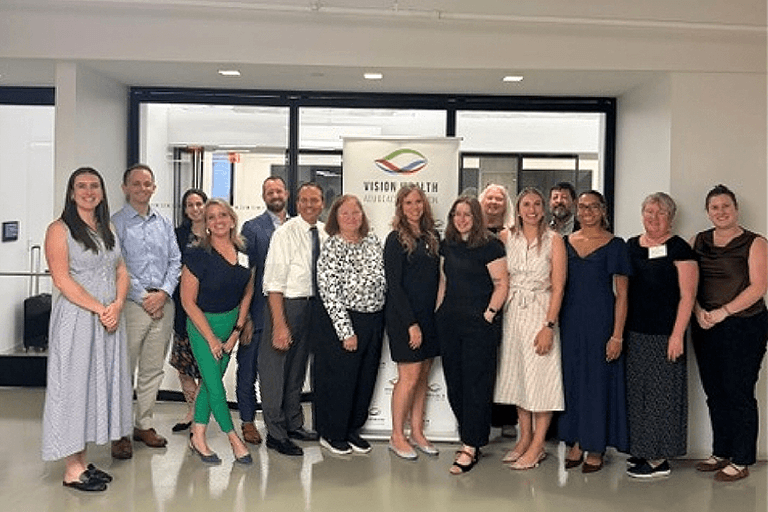
The Alliance for Vision Research joined fellow members of the Vision Health Advocacy Coalition (VHAC) this week for its Stakeholder Meeting, bringing together leaders from across the vision community to discuss shared advocacy priorities, challenges affecting access to care, and opportunities for greater collaboration in 2027. VHAC, a coalition of the Alliance for Patient Access, … Continued
Executive Director Update – August 2026
While that may give everyone inside the Beltway a chance to catch their breath, it also creates one of the best opportunities of the year for the vision research community to make an impact because Members of Congress are back home in their states and districts. And this year, they aren’t alone. Elected officials and … Continued