
Legislative Update – May 2026
The Federal Funding Landscape is Rapidly Evolving
The federal funding and policy environment for biomedical research is entering a pivotal period as Congress shifts from finalizing FY26 appropriations to shaping the FY27 budget. The future of vision research will be determined not only by funding levels, but by policy decisions impacting how research is funded, reviewed, and sustained.
Recent congressional hearings have intensified oversight of NIH operations, grant delays, forward funding, indirect costs, and funding predictability. While Congress preserved relative stability in FY26, the FY27 Administration request proposes significant reductions and structural policy changes that could reshape the research ecosystem.
Funding Trends: Flat Funding and Proposed Cuts
NIH funding has remained largely flat in recent years, with FY26 finalized at $47.2 billion. The FY27 Administration request proposes reducing NIH funding to $41.2 billion.
Similarly, National Eye Institute (NEI) funding has remained flat since FY23, with the FY27 request proposing a reduction to $833 million. Alliance for Vision Research continues to advocate for increasing NEI funding to $1 billion to address inflationary pressures, the growing burden of vision disorders, and the expanding role of vision research across biomedical innovation.
Recent NIH Hearings: Oversight Intensifies
Recent House and Senate hearings involving NIH leadership focused heavily on grant delays, centralized peer review, forward funding, indirect costs, and research funding transparency. Lawmakers from both parties expressed support for NIH while raising concerns about funding stability, reduced paylines, and the long-term impact these policy changes could have on scientific innovation and the research workforce.
These discussions reinforced that structural policy decisions may now impact the future of research as much as topline funding levels themselves.
FY27 Outlook: A Defining Moment for Vision Research
The FY27 appropriations process will largely center around whether Congress rejects proposed cuts, preserves NEI independence, and maintains stability across the biomedical research ecosystem.
At the same time, House and Senate appropriators have accelerated budget timelines, while discussions surrounding indirect cost caps, expanded forward funding, and NIH operational oversight continue to intensify.
Alliance for Vision Research Advocacy Priorities
Alliance for Vision Research continues to aggressively advocate for:
- Maintaining NEI as an independent institute within NIH
- Increasing NEI funding to $1 billion
- Restoring the Department of Defense Vision Research Program to at least $20 million
- Ensuring indirect cost reforms are bipartisan and informed by the research community
- Preserving stability and predictability across the research funding pipeline
A Unified Voice is More Important than Ever
This is a defining moment for vision research advocacy. Protecting and advancing federal investment in sight-saving science will require strong engagement, coordinated advocacy, and a unified voice from researchers, clinicians, patients, organizations, industry leaders, and partners across the entire vision community.
Related News & Events
Legislative Update – September 2026
The Continuing Resolution Keeps Government Open Through December 11 President Trump signed the Continuing Appropriations and Extensions Act, 2027, into law on September 2. The continuing resolution (CR) keeps federal agencies operating through December 11, 2026, generally at current funding levels. It prevents an October 1 shutdown and gives Congress more time to negotiate full-year … Continued

Executive Director Update – September 2026
Over the past year, the vision research community has helped prevent some of the most damaging outcomes facing federal research. NEI remains an independent Institute. NIH funding has been largely preserved. The Department of Defense Vision Research Program (VRP) was restored. And, most recently, Congress delayed a sweeping OMB proposal that would fundamentally change how … Continued
Alliance for Vision Research Joins VHAC Stakeholder Meeting
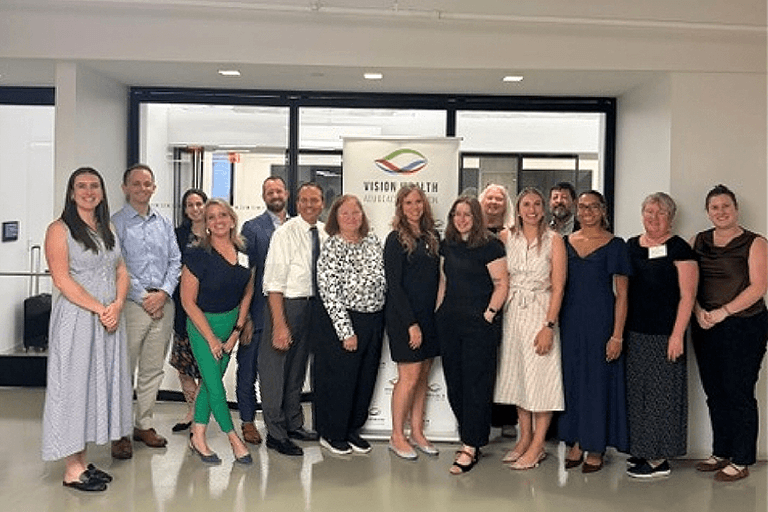
The Alliance for Vision Research joined fellow members of the Vision Health Advocacy Coalition (VHAC) this week for its Stakeholder Meeting, bringing together leaders from across the vision community to discuss shared advocacy priorities, challenges affecting access to care, and opportunities for greater collaboration in 2027. VHAC, a coalition of the Alliance for Patient Access, … Continued